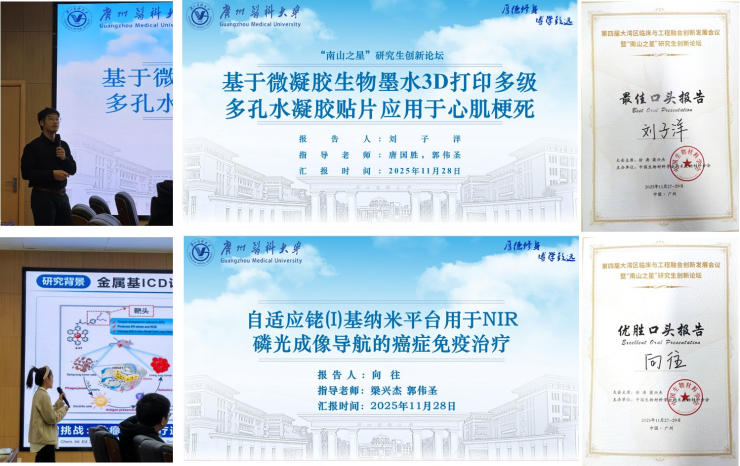
Recently, iCAN Lab’s PhD students Ziyang Liu and Wang Xiang participated in the "Nanshan Star" Graduate Innovation Forum, hosted by the Nanobiomaterials Division of the Chinese Society for Biomaterials and organized by the School of Biomedical Engineering at Guangzhou Medical University. They presented cutting-edge research findings through specialized academic reports. Demonstrating robust research capabilities and innovative study designs, both stood out among numerous participants, winning the first and third prizes, respectively. Their achievements reflect iCAN Lab’s sustained dedication to biomedical engineering and clinical translation research.
Liu Ziyang’s presentation, "3D-Printing Microgel-Based Hierarchical Porous Hydrogel Patch for Myocardial Infarction,"proposed a novel biomaterial design. By optimizing microgel bioink, this work successfully constructed hydrogel patches with hierarchical porous structures, offering new insights for post-myocardial infarction repair. This study integrates 3D printing technology with biomaterial development, highlighting the potential of tissue engineering in regenerative medicine. Dr. Xiang Wang presented a report titled "Near-Infrared Phosphorescence Imaging-Navigated Cancer Immunotherapy" at the conference. The report introduced a novel self-adaptive rhodium(I) complex-based nanoplatform for the precise induction of immune responses and visualization of the immunotherapy process.
iCAN Lab is committed to nurturing research talents with innovative thinking and practical skills, actively encouraging members to engage in high-level academic exchanges. These awards not only showcase the lab’s research prowess in biomaterials and cancer therapy but also advance interdisciplinary collaboration and industry-academia synergy. Moving forward, the lab will continue supporting young scholars in international academic endeavors, contributing further wisdom to the field of biomedical engineering.